Actually – reading Juliet Barkers biography about the Brontes’would lead you to the same conclusions… but this is an interesting article

nonetheless…
Actually – reading Juliet Barkers biography about the Brontes’would lead you to the same conclusions… but this is an interesting article
nonetheless…

Yikes! A flood in Scotland’s National Library. As if books aren’t endangered enough…
We watched “Tropic Thunder” last night. We watched it to the end with our jaws hanging down to our navels. This was a conscious decision, because we wanted to make sure we knew with certainty how far we have come as a society from any limits of good taste. My advice: do not watch this movie. Just as “Knocked Up” rocked me as an example of the decline on our collective morality, this movie confirms my belief that Hollywood should be ashamed of itself. While the great movie moguls of the early 20th century decided to produce pro-America films which helped create our sense of national pride during WWII, Hollywood is now devoted to ripping down any shred of dignity or right and wrong the old boys created.
While “Knocked Up” made a joke out of casual sex and out of wedlock birth, this film denigrates human dignity further under the guise of making fun of Hollywood. I suppose that makes it ‘okay’. Certainly, this notion of the open mindedness of Hollywood; letting a filmmaker create ‘satire’ which denigrates the very industry he ‘works’ in, seems to be the very epitome of open minded liberality. But that just magnifies the problem. When will too much be too much, no matter how tongue in cheek?
Consider me a former fan of Ben Stiller. I will never watch “Meet the Parents” again on HBO or DVD in protest. The Robert Altman movie, “The Player”, did a much more subtle job of showing what all of us on the outside with our noses pressed to glass already suspect: Hollywood is a big hunk of rotting meat stinking up our sense of self worth and dignity. They have turned everything topsy turvy.
But Tropic Thunder is a bridge too far, to use a war metaphor for this movie about a war movie. Gratuitous violence and gore is something to be not only tolerated, but embraced, hee hee. With “Knocked Up” it was casual, hook up sex and okie dokie, cutesie wootsie, out of wedlock birth that was in your face, ‘I dare you to even as much as blink your disdain’. As a result, single women having eights babies paid for with disability payments with no means of visible support is taken matter of factly.Quick! Get Ann Curry in there to interview the Angelina Jolie look alike! In “Knocked Up,” pornography is a right. Heck, the future deputy Attorney general of the US defended pornographers. No biggy.
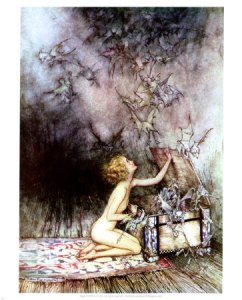
I write this as one baying at the moon. The train has left the station, the genie is out of the bottle just to mention a few cliches. Pandora’s box is well and truly open…
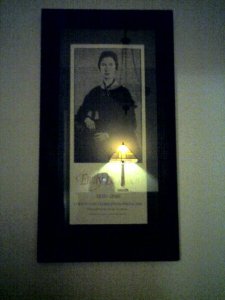
I have been reading two biographies about Emily Dickinson. The first, White Heat, is beautifully written. This book, which is a biography about the friendship between Emily and Thomas Wentworth Higginson, has many lovely passages such as this one which describes The Homestead, Emily’s home, now a museum, “The Homestead… is spare of furniture; the rooms are cold, and though the docents are helpful, the poet has fled.” I agree with Ms. Wineapple. The Homestead is indeed not haunted. But the same can not be said about The Evergreens, the house next door. The Evergreens was built by Emily Dickinson’s Father for her brother Austin and his bride, Susan Gilbert as a sort of bribe. The elder Mr. Dickinson (Edward) was trying to convince Austin to remain in Amherst rather than go west to Chicago.
While The Homestead is decidedly ghost free, The Evergreens is not. The Evergreens ironically became a hub of Amherst society while Emily was steadily withdrawing from that same society. Next door to Amherst’s famous recluse, Emerson and Henry Ward Beecher were received and feted. Today, the house is in a serious state of dilapidation, yet it retains most of the original contents. While dusty and seriously frayed, the chair Emerson is said to have occupied in the parlor looks as if he could emerge from another room and sit down once again to engage in conversation about the lecture he completed at Amherst College a mere 142 years ago. Yet, the house is eerie. When entering the dining room where Susan Dickinson entertained her guests, there is a noticeable drop in temperature (even in the summer). A chill hangs in the air over the table which looks as though it is set for a spectral dinner party.
But the downstairs isn’t the creepiest part of the house, that honor belongs to the upstairs of The Evergreens. Ascending the creaky back servants stairs, the visitor is most acutely struck by the lingering souls of long dead Dickinson’s. The nursery of Gib, Emily’s little nephew who died tragically of typhus at the age of seven, remains exactly as the Dickinson’s left it after his death. Apparently, in her grief, Sue just closed the door and NO ONE every went back in. The feeling of voyeurism is palpable.
However, The Evergreens present a remarkable opportunity to look in on the past exactly as it was, not as a restoration or a recreation of a historical landmark, but as it actually looked (albeit with some deterioration) the last time the occupants left the rooms. It sends chills up the spine. It is just plain spooky. The day I took the tour for the second time, by the time we reached the nursery, early winter darkness had decended and we gazed in upon the doomed little boys nursery by electric lamplight, the lamp swinging in the docent’s hand, sending shafts of weak light into the poignantly charming, yet deathly still
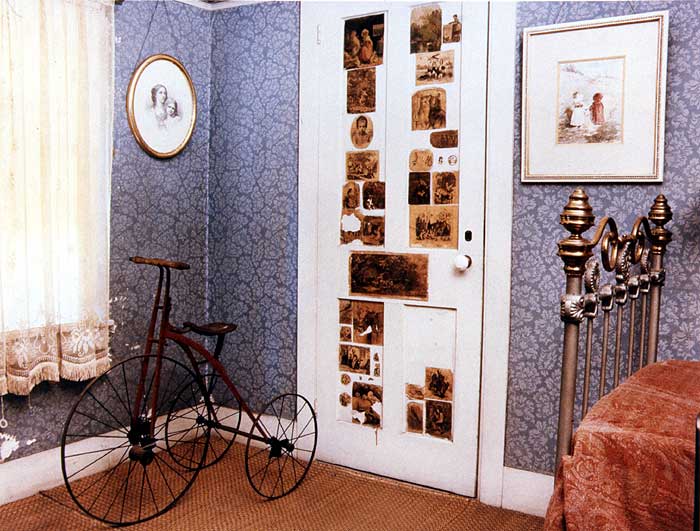
room. Emily’s words echoed in my head, “I am out with lanterns looking for myself…” The Evergreens is the saddest museum in America. If there are such things as ghosts, they surely walk at The Evergreens.
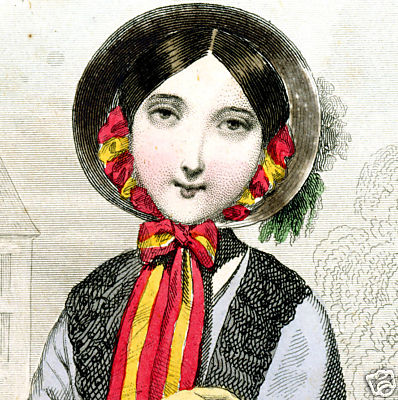
She reminds me of Jane Eyre.
In March of this year, researchers completed a study which concluded a certain degree of our ability to experience varying levels of happiness is indeed genetic. Likewise, there are studies which reveal the genetic markers controlling the degree to which humans will experience shyness as well as other behaviors such as hostility. The secular, scientific age we live in gives us partial answers to age old questions. Yet, in spite of these conclusions, science is not able to categorically conclude all behavior or personality is something we are born with or derived solely from biology. It appears that at least fifty percent is left to chance and it is within that fifty percent we are either shaped by our own ability to decide or we are shaped by circumstance and other variables such as the influences of family, peers or society.
Self knowledge can be identified early in life. Certain symbols can become life long certainties. Like a ballerina spotting an object while she twirls, there can be focal points which remain with us always. These are decisions we formed on our own and are hard to dislodge. For a long time, I have privately referred to it as the Rosebud Theory and I base it on my own love of pink rosebuds. I can personally remember as far back as two years of age, wanting and needing to see, wear, have pink rosebuds. It was visceral. I wanted my dresses to be adorned with them, I was drawn to baby dolls with “rosebud” mouths. Illustrations in picture books decorated with rosebud borders became my favorites. No matter what I have done or experienced in life, the one constant has been rosebuds. Metaphorical rosebuds for sure, represented by the kind of books I like to read, the movies I like to watch, the hobbies I have. All are akin to the romantic beauty of a rosebud. This is the self I create and hold sacred; and while it may not necessarily be a ’rosebud’ for other people, I believe there is something similarly representative in everyone’s deeply embedded core. Something, which, like a rosebud, remains constant to define them, on their terms and will unfurl to become a complex person based on the bud that defines our innate preferences.
When a boat is tethered by a single line to a dock, it may drift in a myriad of directions. Depending on the conditions of the wind it may drift close to the edge of the dock, safely bumping against the moorings, sheltered somewhat from the wider lake. Or, the wind may kick up and pull the boat out far from the dock, the line taut and strained to a breaking point, far from the original source of safety. Humans are like this. We can be influenced by forces, be they powerful personalities or intervening circumstances, to drift a long way from our original mooring. It may be hard to remain tethered to ideas we form on our own. We may indeed find the influence of ideas we encounter or people we meet overpowering and may even abandon convictions, change our behavior based on the tug of society’s powerful currents. These changes may occur through personal choice or in subtle forms of coercion
It is human nature to believe you are in charge of your opinions or actions. And while, as I briefly alluded to, science can explain some of our behavior as being genetic it also makes sense this genetic basis is malleable. In the happiness study I referred to, the researchers were able to conclude a person’s ability to increase their degree of happiness was dependent on circumstance. So while our “happiness set point” might be one we are born with, the effects of circumstance can increase or decrease our propensity to experience true happiness. Likewise, it is logical to assume other kinds of circumstance can alter who we are or think we are.
During the run up to the recent election, I found it intriguing to read the brief, yet explosive posts written on the social networking sight ‘Twitter’. One in particular caught my eye. The person posting posited the question “Is it possible to be married to someone who votes opposite you?” The responses that poured in were overwhelmingly “NO!” This reaction made me wonder how many of those relationships were genuinely comprised of two individuals who came to a relationship with completely sympathetic views. I pondered the possibility of one personality overcoming another to accomplish such a completely synchronized view. In this way, it is easy to see the extent to which others can create us. If the tables were turned, perhaps if the individual was married to another kind of voter, their preference would or could be altered. Like the boat tethered to the dock, the wind whips you in one direction or another and the circumstances of the situation, the inter-personal relationships, alters what may lie at your core.
However, you may never relinquish your most deeply held love of rosebuds…
+copy.jpg "memory1")

No Country for Old Men – Shoot, kill, monster guy, shoot kill some more, dreadful, horrible, greed, blood, shoot, shoot, hopeless awfulness, good guy loses, bad guy ends up with a broken arm, older generation is irrelevant and talks gibberish. The End. Okay, the writing was quite good. A watch -able (like a train wreck) film with a sick premise. Big Sigh.
There Will be Blood – They should have used this title for No Country for Old Men, because there wasn’t much blood, just a lot of dirty fingernails, grimy, sweaty, dirty, mean, horrid, awful, people and grunge. There was blood at the end when the despicable, selfish, most likely stinky due to lack of baths old guy whacks the stereotypical Jimmy Swaggert-like sniveling, ridiculously big crucifix wearing bible banger guy with a bowling pin. Oops. I should have said spoiler alert. Sorry. Plot ends midway through movie and it meanders to a short story ending of drunken, sweaty nothingness.
An aside about the short story ending…I have to say a few words on this topic. If you read a lot of short stories, you will find many just … end… boom. No rhyme. No reason. I myself use this technique occasionally because for some reason, it is seems to be the preferred way to wind up a short story, or not wind it up as the case may be. I personally think it is laziness. Some trendy, popular author (in the case of There Will be Blood, Upton Sinclair) ran out of things to say and said to himself “I think I will submit this to see what happens and like The Emperor’s New Clothes, the hapless, sycophant publisher thinking he must be missing something, but doesn’t want to give away his lack of sophistication publishes it and Voila! A literary technique is born. Oh well.
Back to movies…
Bella – Cliché, stupid, did I say cliché? Oh, and it is also cliché. Plot moves forward cliche-ly as follows- another aborted abortion, angst, angst. Cliché angst. Stupid use of scarf. No one wears scarves like this anymore. Movie is a combo plot: Like Water for Chocolate meets Sunshine of the Spotless Mind with a twist of Juno. And this won awards at Sundance? My regard for Sundance plummets. (What is it with Hollywood, and abortion? They are doing mea culpa’s for Roe vs. Wade at an alarming, head spinning rate. Their message is so confusing, no wonder so many young girls are getting pregnant and having the baby and romanticizing the whole thing, I think it is irresponsible.)
Into the Wild – This is actually a good movie. Read the book by Jon Krakauer first, it is really good. He is a wonderful writer then, watch the movie. However, I don’t think Chris McCandless is a hero. I think he must have been troubled and he was foolish. Google Into the Wild and read the many articles, like this one and this one. But so far – it was the best movie.
Live Free Die Hard – Why did I watch this? To make my husband happy. He fell asleep, Emma and I watched it to the bitter end. Why? Why? Oh Why?
And so I write again, loveliness. I am dedicating my blog to the pursuit of loveliness, hence, the picture. Isn’t it lovely?
 I should have been a costumer. I think that is why I make dolls. So I have a body to make a pretty dress for.
 Paraphernalia
